CDHB
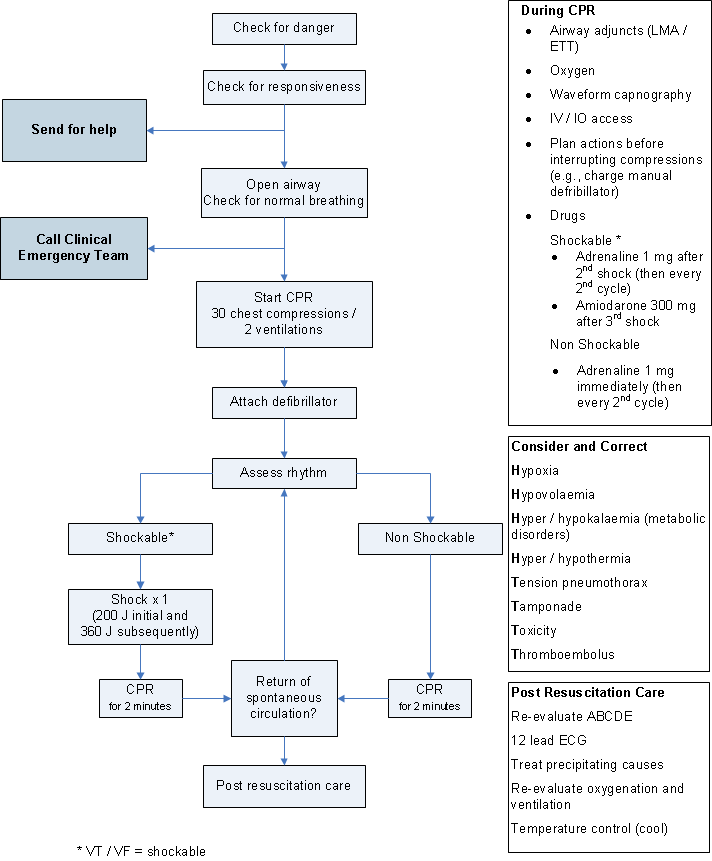
Commence basic life support unless the patient’s status is DNACPR. Use the ABCs of CPR. Call for the Clinical Emergency Team and resuscitation trolley. Consider precordial thump if monitored or witnessed and a defibrillator is not immediately available.
REMEMBER:
Note: Exclude the possibility of monitor failure resulting in apparent asystole.
Adult In-Hospital Resuscitation
Adult In-Hospital Resuscitation
Authorized by the CDHB Resuscitation Coordinator 2011.
Cardiopulmonary resuscitation (CPR) can be lifesaving, particularly in the hospital context where effective CPR can be commenced very quickly. Cardiac arrest may be due to an acute and potentially reversible event and CPR can be effective at restoring cardiorespiratory function and allowing recovery.
CPR is the default option within all health care facilities in New Zealand unless an advance decision is made that CPR should not be attempted.
More commonly however, cardiac arrest is the final event in the dying process and for many patients with advanced illness, CPR has virtually no prospect of success and may be either unsuccessful or leave the patient worse off.
DNACPR stands for "Do Not Attempt Cardiopulmonary Resuscitation" and is the medical order in the CDHB which indicates that CPR should be withheld, allowing the death of that patient from natural causes or inevitable progression of their illness.
DNACPR status must be clearly displayed in the patient's notes. If this order is not apparent then as indicated the default position is to carry out CPR.
For further details, see Cardiac Arrest.
Topic Code: 1335