Management Guidelines for Common Medical Conditions
"The Blue Book"
15th Edition 2013
Date of Issue: 1 December 2013
Expired: 1 December 2016
This edition of the Blue Book is no longer being maintained – use at your own risk.
This site will close on 1 March 2017.
 The Blue Book has been replaced by Hospital HealthPathways.
- Canterbury DHB replaced the Blue Book with Hospital HealthPathways, which complements Community HealthPathways.
- Canterbury DHB invites other New Zealand DHBs to join the collaborative.
- For more information, contact the Canterbury Hospital HealthPathways team by emailing CanterburyHospitalHP@healthpathways.org.nz.
Release Notes - Subsequent Updates to the 15th Edition
December 2015, November 2015, October 2015, September 2015, July 2015
About the Blue Book
Authorized By: 'Blue Book' Editorial Committee
Executive Editor: Mike Beard
Editorial Committee:
John Thwaites (Chair)
Paul Chin
Barry Colls
Suzanne Faville
Greg Frazer
Mark Jeffery
Sharon King
Sarah Metcalf
David Richards
Andrew Sidwell
Mary L. Young
ISSN 1176-4678 (Print)
ISSN 2463-4697 (Online)
Ref. No. 0070
Disclaimer and Copyright Notice
Medicine is an ever-changing science. As new research and clinical experience broaden our knowledge, changes in treatment and drug therapy are required. The editors and the publisher of Management Guidelines for Common Medical Conditions otherwise known as The Blue Book, have checked with sources believed to be reliable in their efforts to provide information that is complete and generally in accord with the standards accepted at the time of publication. However, in view of the possibility of human error or changes in medical sciences, neither the editors, nor the publisher, nor any other party who has been involved in the preparation or publication of this work warrants that the information contained herein is in every respect accurate or complete and shall have no liability for any loss or damage arising out of any reliance on this information.
Readers are encouraged to read the product information sheet included in the package of each drug they plan to administer to be certain that the information contained in this book is accurate and that changes have not been made in the recommended dose or in the contraindications for administration. This recommendation is of particular importance in connection with new or infrequently used drugs. Readers should also consult their own laboratories for normal values.
The Blue Book has been compiled by the staff of Canterbury District Health Board (CDHB) and as such CDHB has copyright for this book.
No modification is to be made to clinical content without approval of the CDHB Blue Book Editorial Committee. No release of part of, or all of, the Blue Book to any other party or organization is permissible without the prior approval of the committee.
© 2013, Canterbury District Health Board
Introduction - Fifteenth Edition 2013
A formal continuing medical education (CME) programme for Physicians began in Christchurch in 1979. Medical audit, carried out as part of this CME programme, revealed a need for standardized treatment guidelines to improve medical care. Through the vision and energy of Dr Mike Beard, this was achieved and the first edition of the Blue Book was produced in 1983. Each subspecialty continues to produce recommendations for every new edition. This handbook has proven very popular among RMOs and Specialists alike, not only in Canterbury, but nationwide.
These guidelines are not designed to be followed in a rigid manner. The treatment given to the patient must always be considered in the light of that patient's individual problems and needs. Although these recommendations may often need modification in practice, they should provide a useful guide to the provision of good medical care. In several areas, we refer to National and International guidelines. If our guidelines differ, then this reflects the current practice at the CDHB. Our guidelines do not apply to Paediatrics.
Remember that the delivery of medical care is a team activity. Always listen to advice from the patient and relatives, from other members of the staff and from the General Practitioner. Try to obtain as much accurate information about the patient as possible. Obtain all available past medical notes, and if necessary telephone the General Practitioner. In some situations, for example a suspected seizure, an interview with a witness may prove to be crucial. Above all remember that patients are people and that coming into hospital is probably the most stressful thing that has ever happened to them. Relatives may be fearful that they are about to lose a loved one. The correct treatment is devalued if it is given in an uncaring or inconsiderate manner and the reasons for giving it are not clearly explained.
Finally, remember the financial costs of your actions. It is often possible to save money by avoiding expensive treatments and investigations when adequate, cheaper alternatives are available.
We are pleased to acknowledge the enthusiastic help we have received from the many Consultants, Registrars and other hospital staff not only in Medicine but from other disciplines at CDHB. We are very grateful to Drs Ken Boon, Tamara Brodie, Thomas Evans, Niall Hamilton, Timothy Hii, Heather Isenman, Mike Liu, Aileen Ludlow, Clare Pate, Laura Sellers, Avinesh Shankar, Preechapon Tovaranonte, Emma Trowbridge, and Thomas Upton for their assistance with proof-reading, and to Helen Noble for her secretarial support. This edition has been produced by Emma Harding of Streamliners NZ Ltd (www.streamliners.co.nz) in the appropriate format for hard copy, intranet, and PDA/smartphone versions. We would like to acknowledge the financial support of Canterbury District Health Board.
Note: These Guidelines must be used in conjunction with the CDHB Early Warning Scores and Policy and the Preferred Medicines List ("The Pink Book").
On 1 December 2016, Canterbury DHB retired the Blue Book and replaced it with Hospital HealthPathways.
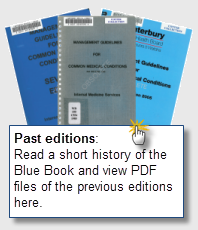
View past editions of the Blue Book